The figure of the artist Temo Svirely illuminated the artistic life of Kyiv at the turn of the millennium, flashing briefly across the horizon like a bright comet. All his works are unforgettable. Because the paintings born of Temo's Eastern imagination contain complex, carefully structured meanings. They seem like fresh improvisation, and look as though we have returned to the sources of artistic creation, to the misty period of Gothic, Persian, Median, and in general pre-Christian magical memory. Because the artist, it turns out, is capable of living many lives.
The heroes of his paintings are often mystical characters: mysterious diadochi, kings, warriors, unicorns, who appear to adorn the mundane, impoverished matter of existence. These visitors from fairy tales come from a hallucinatory, dynamically dreamlike world of the subconscious, the hidden, the taboo, where the characteristic features of good old surrealism begin to show through. The eternal return of these heroes of the old fairy tale into existence holds them within the boundaries of a dangerous yet divinely cosmic dichotomy. Such is the artist's will.
In the sharp juxtapositions of color, in the harsh, angular lines, some primordial drama has frozen – one characteristic of heroism, perhaps from the Bronze Age, from the times of the Trojan War. You almost expect to see on these canvases the peaks of the Caucasus, the ark on the slopes of Ararat. In Temo's paintings, a different time is captured. This very state arises when reading the Apocalypse; it is the ecstatic style of the Revelation of John…
The incredible shapes of heads, faces, bodies, the perspective lines of the painting are fractured, as if broken by some insurmountable emotional dynamism, a spiritual shift, a shock. Such fragmented and re-formatted volumes were encountered as an artistic device that gave birth to Cubism. One example is Picasso's style of the 1930s-50s, his sculptural assemblages and first surrealist montages.
In Svirely's graphic work, the influence of Georgian repoussé metalwork is strongly felt; in his profiles and figures, traced with a precise, willful line, one senses the foundation of metal, the heavy copper texture of a craft object. This is an astonishing, stunning sensation. The tense repoussé contour, the detailed and meticulous modeling of individual elements: dots, spots, dynamic swirls – such techniques are characteristic precisely of ancient Caucasian masters. The clear drawing with Renaissance expressiveness specifically emphasizes the expressive plasticity of forms. Monumentality, the pictorial completeness of composition, is organically complemented by the careful development of plastic volumes, while the fantastical repoussé detail harmonizes with the overall mass of the whole.
The artist is extraordinarily fond of textures, of thick dough-like paint. He takes great pleasure in feeling all this mobile mass, subject to his will, feeling its resistance and submission, and applies it to the surface with a palette knife or brush – sometimes in two or three, sometimes in ten layers. Whatever Svirely paints, the painting gives the impression of flow, vitality, of a sketch – in accordance with the internal dynamics of one form or another. The paint is applied to the canvas in a viscous mass, solidifying in lumps of variegated lava and sometimes coming to resemble dense, metallic enamel. His special, unique technique of working with covering varnishes, sometimes up to five layers, is applied over the depicted narrative scenes. The painting appears as if flooded with a special light, a gleam that shines from afar with a particular iridescent Byzantine darkness.
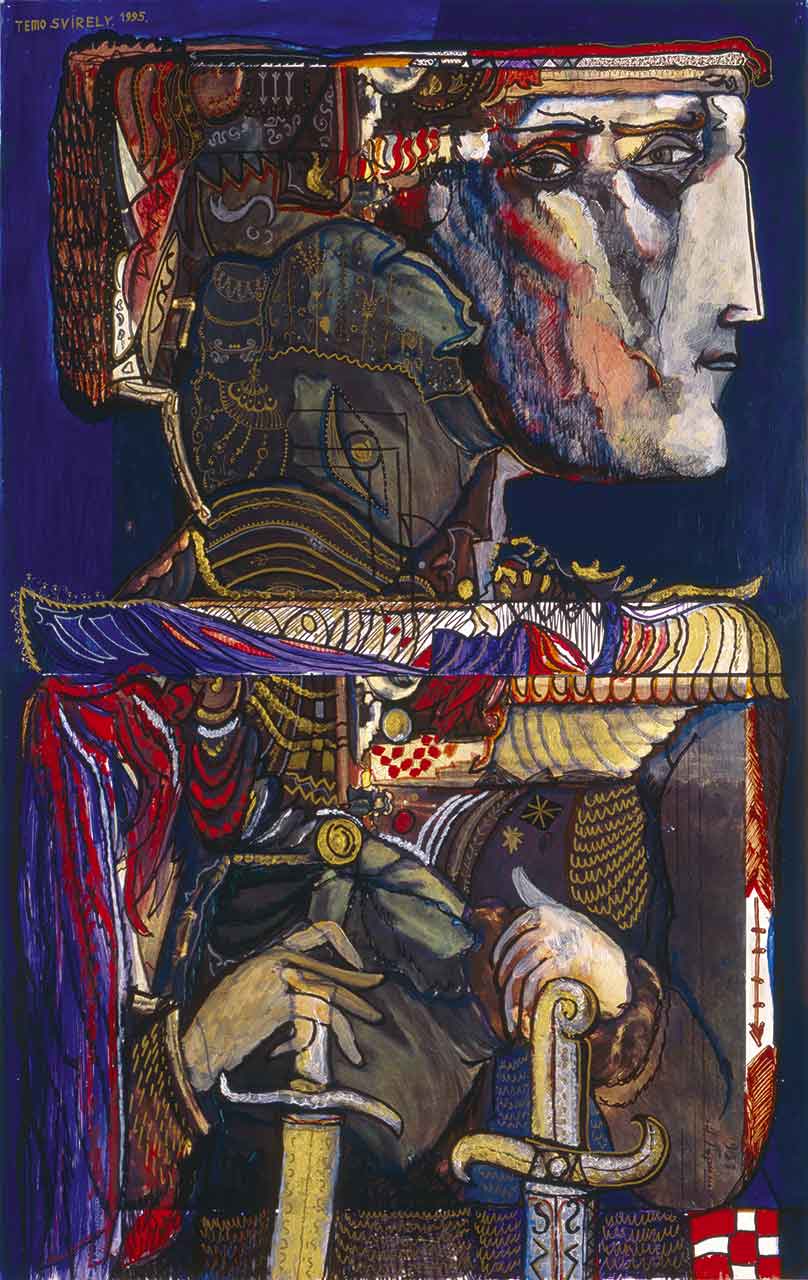
And the maximum generalization of the image, especially in the portrait, with clearly distributed segments of the environment, involuntarily evokes decorative Eastern miniature or Romanesque stained glass. The very soul of his art remembers its ancient incarnations. And leaving behind the first impressions of obscurity and incompleteness, it remains filled with the energy of life – constant, knowing, inquisitive.
In Temo's work, as if a witness to strange events, there often appears a character ‘full of eyes’. Who is this? Perhaps a wise divine omnipresence? What is this? Perhaps an expression of an insatiable desire to grasp as many phenomena and events as possible? Creatures full of eyes in front and behind (Revelation of John 4:5-6) are described in Holy Scripture. Such eyes give these living witnesses the ability to see everything at once… and they are remarkably pure. Here too, one frequently encounters a character whose both eyes are located on one facial plane – like the head of a flounder, flattened by marine, or rather, spiritual, pressure. This is so expressive and mystical.
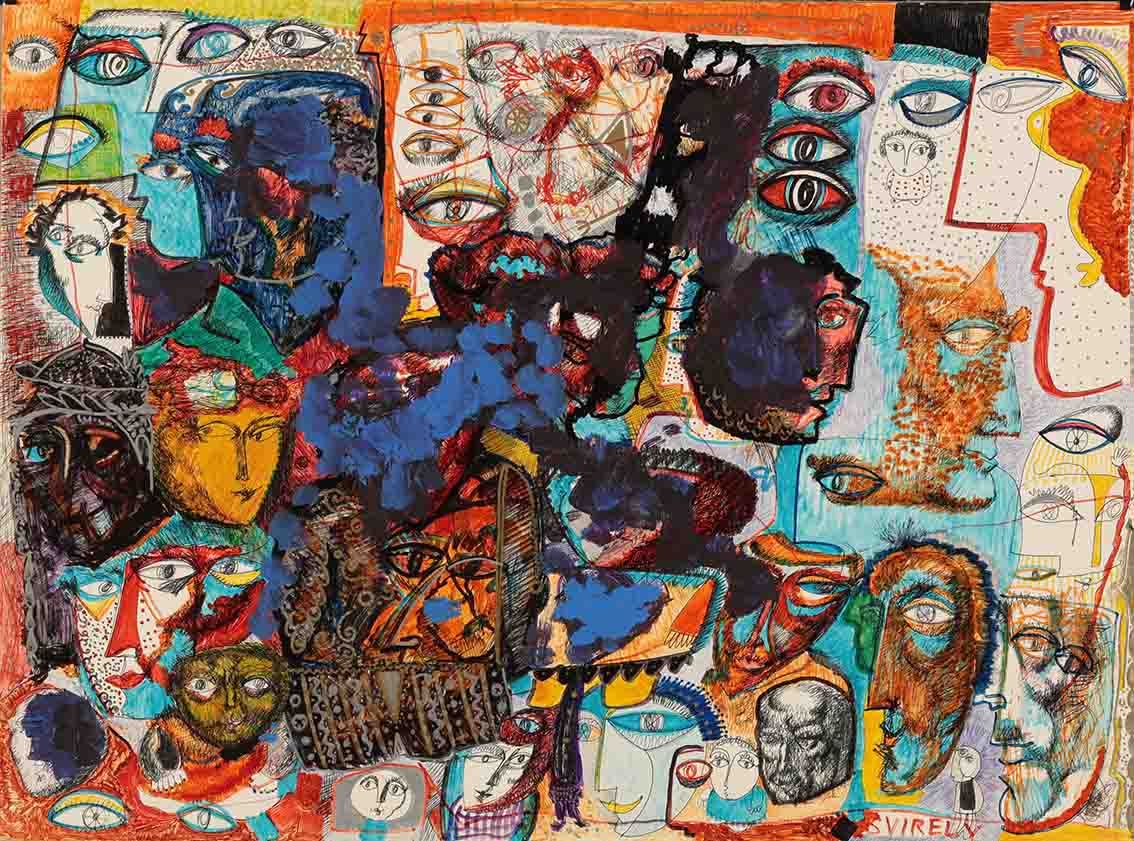
One would also like to say a few words about the special humor that often permeates Svirely's paintings. The humor is revealed not so much in external grotesqueness, not in distorted proportions or in the strange, even comical activities of the characters. It is about a special mood, an organized emotion that shuns logic, simply all adult boredom and moral unfreedom. The humor here is cosmic. It resides within personal notions of the world, that is, within humanity's PLAY with existence in the ‘all-too-human’ and the divine planes. "Because tears relate to mortal and perishable things, while laughter signifies the joyful fullness of universal action… we allocate laughter to the birth of the divine but tears to the emergence of men and beasts." (Paraphrased from Proclus, Neoplatonist). This state of good humor in Svirely's painting is the optimism of a child or a peasant caressing a grape cluster, in joyful hopes and trust in life.
Works
Hell
The ideological dominant here is a cruel eye, as if carved into the prow of a battle trireme. It turns out this is the eye of some young god who cheerfully contemplates the destruction of organic flesh as part of a world being created anew around him. The profile character constantly appears in Temo's paintings. The eyes look slightly to the side, mockingly – in contrast to the canonical gaze of Christ, who looks straight into one’s eyes with solemn seriousness…
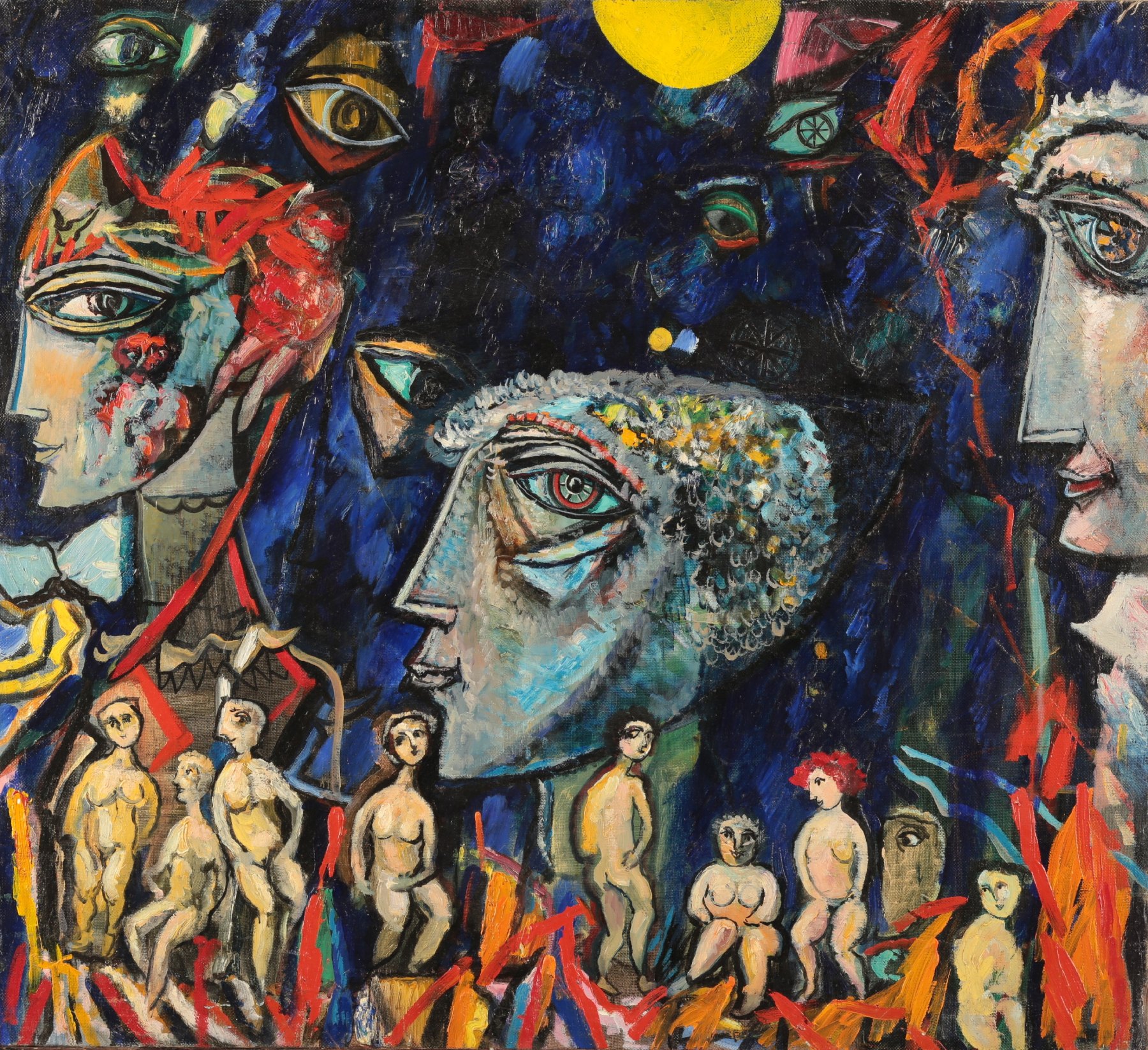
Hell (1997), oil on canvas, 110х100 cm
Dense blue colors thicken to the point of black voids, and within them appear the golden and pinkish bodies of tiny figures, along with tongues of flame in the infernal space. One involuntarily recalls the glowing ditch from Dante's poem: "So each of those flames moved, along the throat of the ditch” (Inferno, XXVI). This tense vision is accompanied by the glow of celestial fires, as an expression of inaccessible and lost worlds. And the people here are clumsy and funny, hastily fashioned, touchingly unconscious in their existential reverie, and they form something like a Colchian pattern on the plane of the canvas.
Son of the Sun
Here the artist's creative impulse is guided by a cognitive, almost Achaean, battering energy of the divine profile, a mighty god crowned with the point of a unicorn. The authority, the royal refinement of an Eastern diadochus who melancholically endures the heat of the southern luminary – appears as the energy of ancient solar cults, hushed hymns of Zoroastrianism. "I curse the daevas as a worshiper of Mazda, as a follower of Zoroaster, I promise everything good and everything best to him, the righteous one. I promise righteous light and paradise" (Paraphrased, Avesta).
And the horns on the brow of the Son of the Sun always, even in the Gospels, indicate strength in battle (Deuteronomy 33:17). Christ Himself is the sacrificial Lamb who bears horns for combat. He fights against evil. This struggle of His takes place within the fullness of God's movement, which will continue until the sound of the Seventh Trumpet, by which the mystery of God will be completed. A whirlwind and shimmer of solar monads, resembling gold coins or ancient swastikas, saturates the dark space of worldly evil.
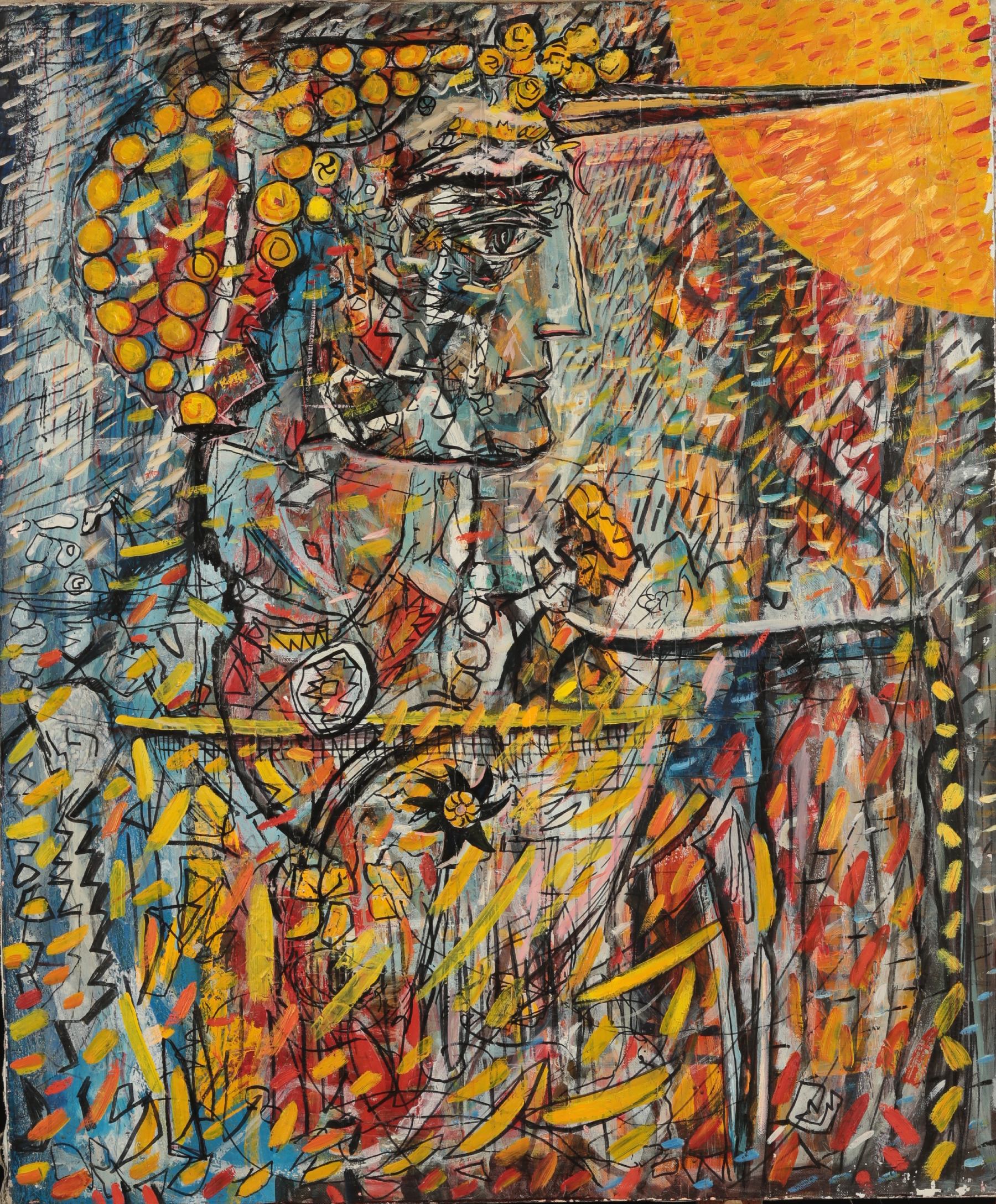
Son of the Sun (1997), oil on canvas, 120х100 cm
Portrait of a King
Depicted is a descendant of the caste of magi, in a regal collar, with the obligatory scepter in hand: "And there was given me a reed like unto a rod" (Rev. 11:1), and a sun-shaped ring on his index finger. The background for the royal figure is a nocturnal Chaldean abyss, heavy draperies embroidered with stars. His face in profile is illuminated by a smile of perfect composure, like the eloquent thought of an Eastern ruler. This is, perhaps, the very ancient soul of the Iranian plateau.
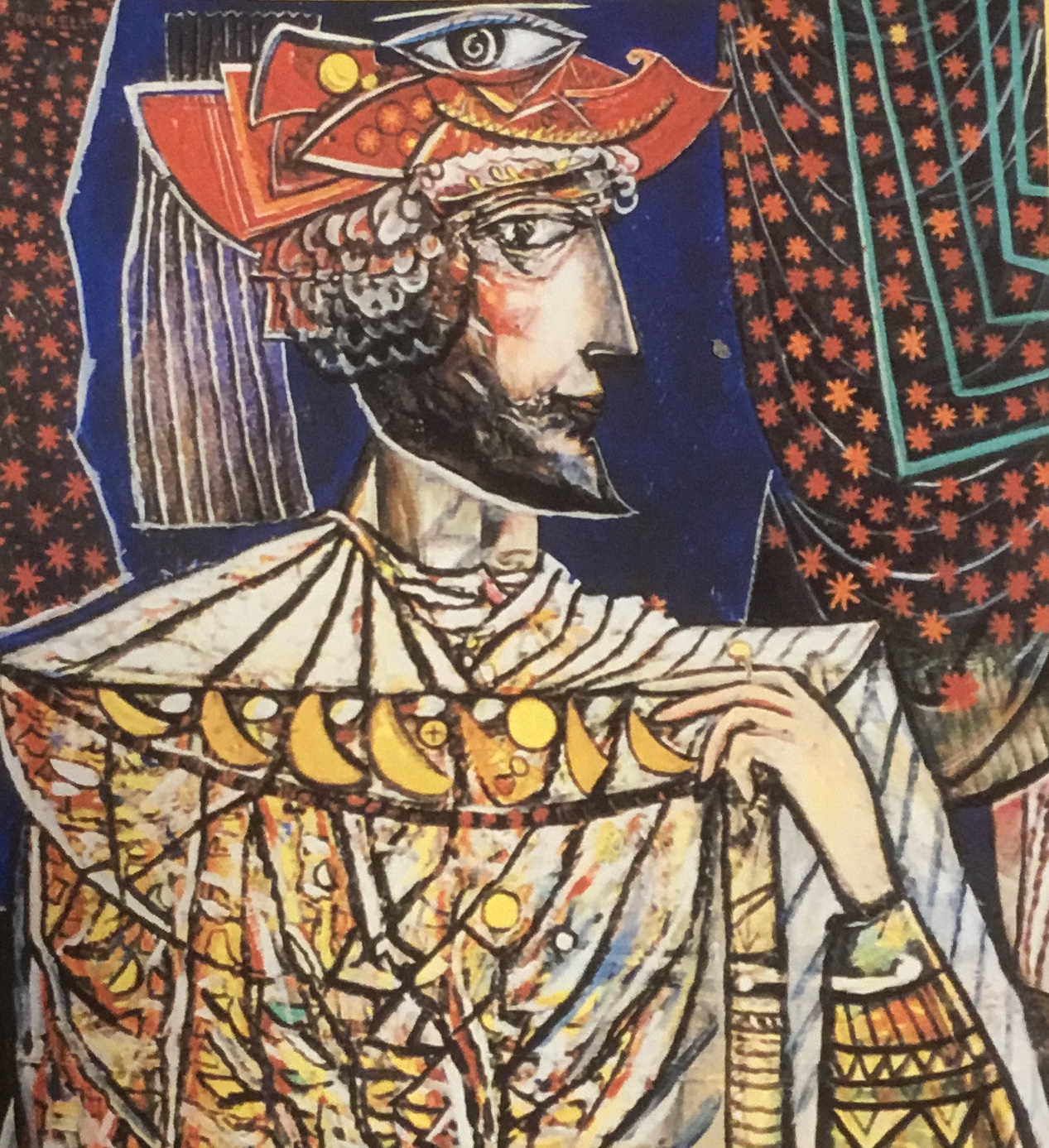
Portrait of the King (1997), oil on canvas, 120х100 cm
Portrait of the Artist with a Raven on His Head
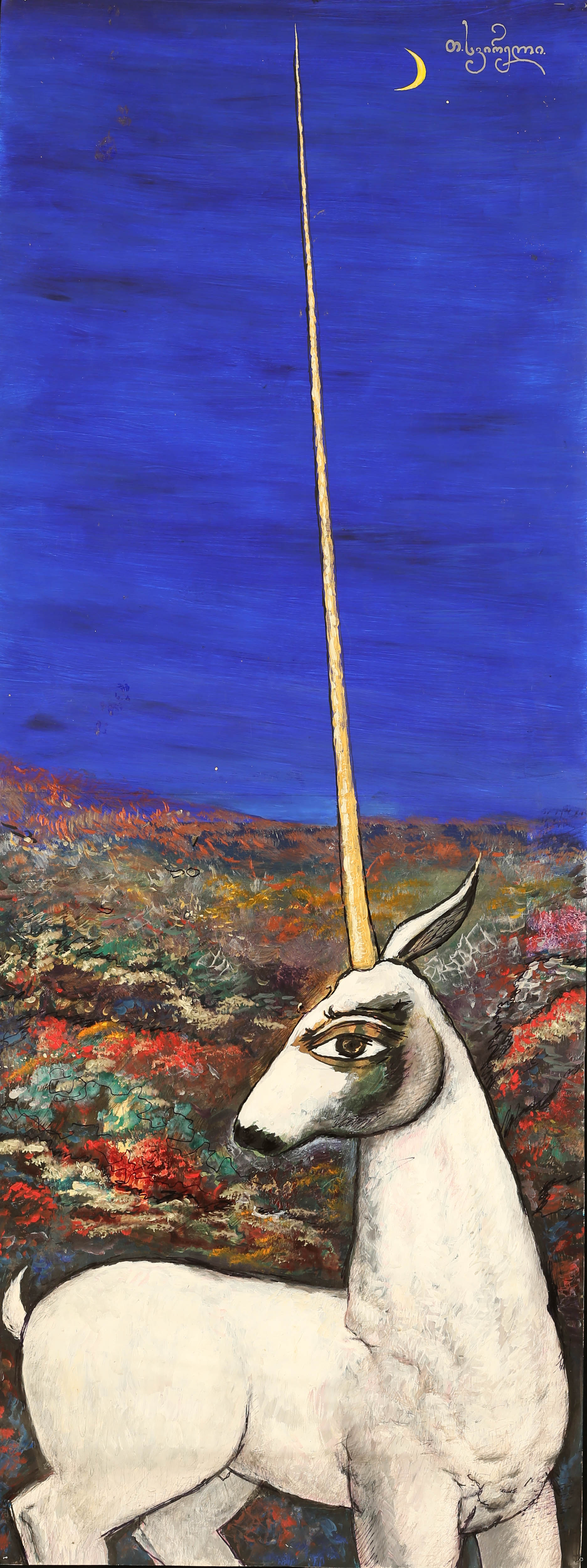
Temo humorously depicts the half-figure of a master with a raven on his head, with a childlike, slightly awkward carefree mood. This is an appeal to the bird as the winged part of the soul, the organic lightness of being, as a totem of a creative lineage. The Unicorn appears especially often in the artist's work – a symbol of purity, companion of the Virgin, a figure in Renaissance Madonnas, a dreamy inhabitant of the Garden of Paradise. He is the one who tames the darkness, the destructive influence of the lower world.
"There is sorrow, a certain sadness in the world. This sorrow is like a closed, burning space. Then it is so important to know that hell will end, and to emerge from the confinement, to reach out a hand, to touch the world, even when that passage becomes a new suffering. But indifference and lovelessness do not create form, for this is unthinkable for the soul. For there is no form without love," Temo believes.
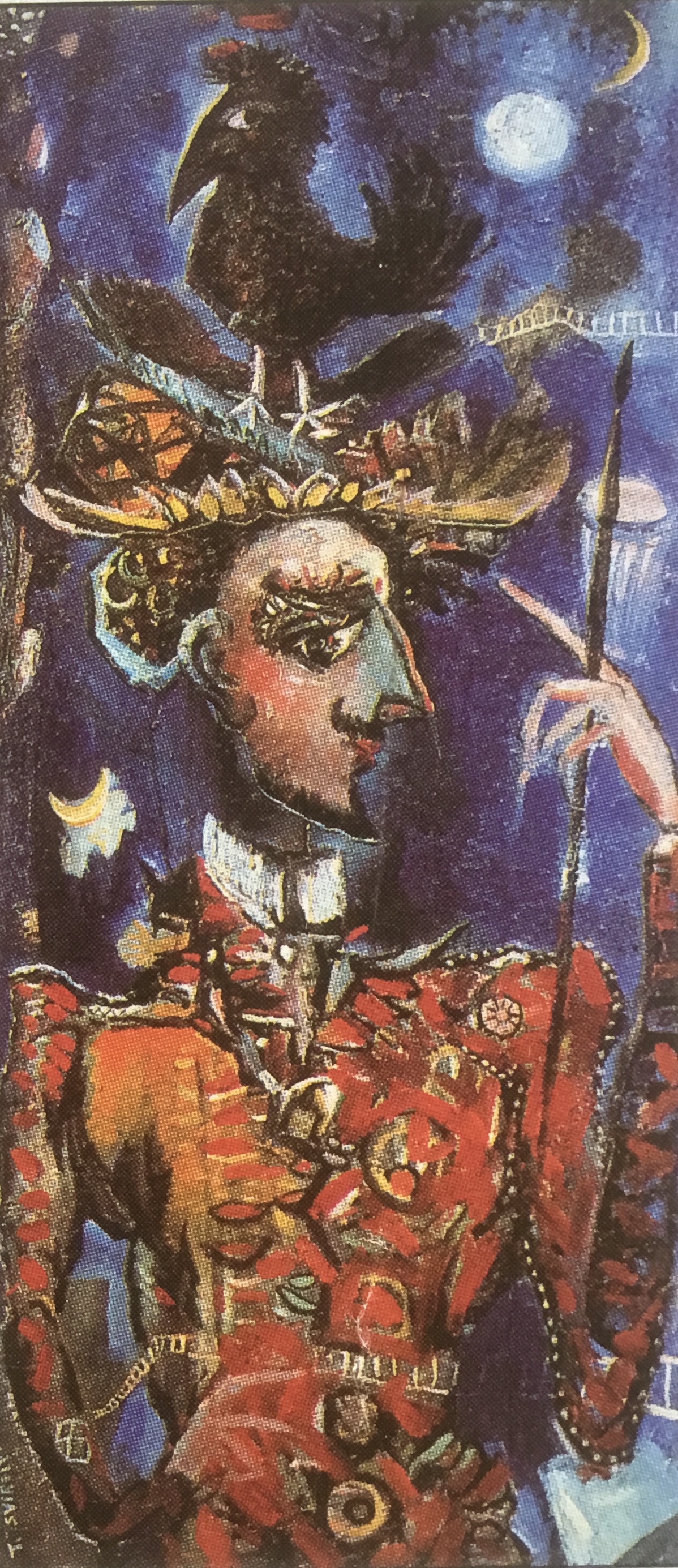
Portrait of the Artist with a Raven on His Head (1998), oil on canvas, 60х130 cm
Perhaps this is precisely why another character enters the artist's subjects – a delicate, petal-like boy, a tsarevich, a prince. Here the world of childhood reveals itself as we remember it from within – the image of inner joy that grows through knowledge.
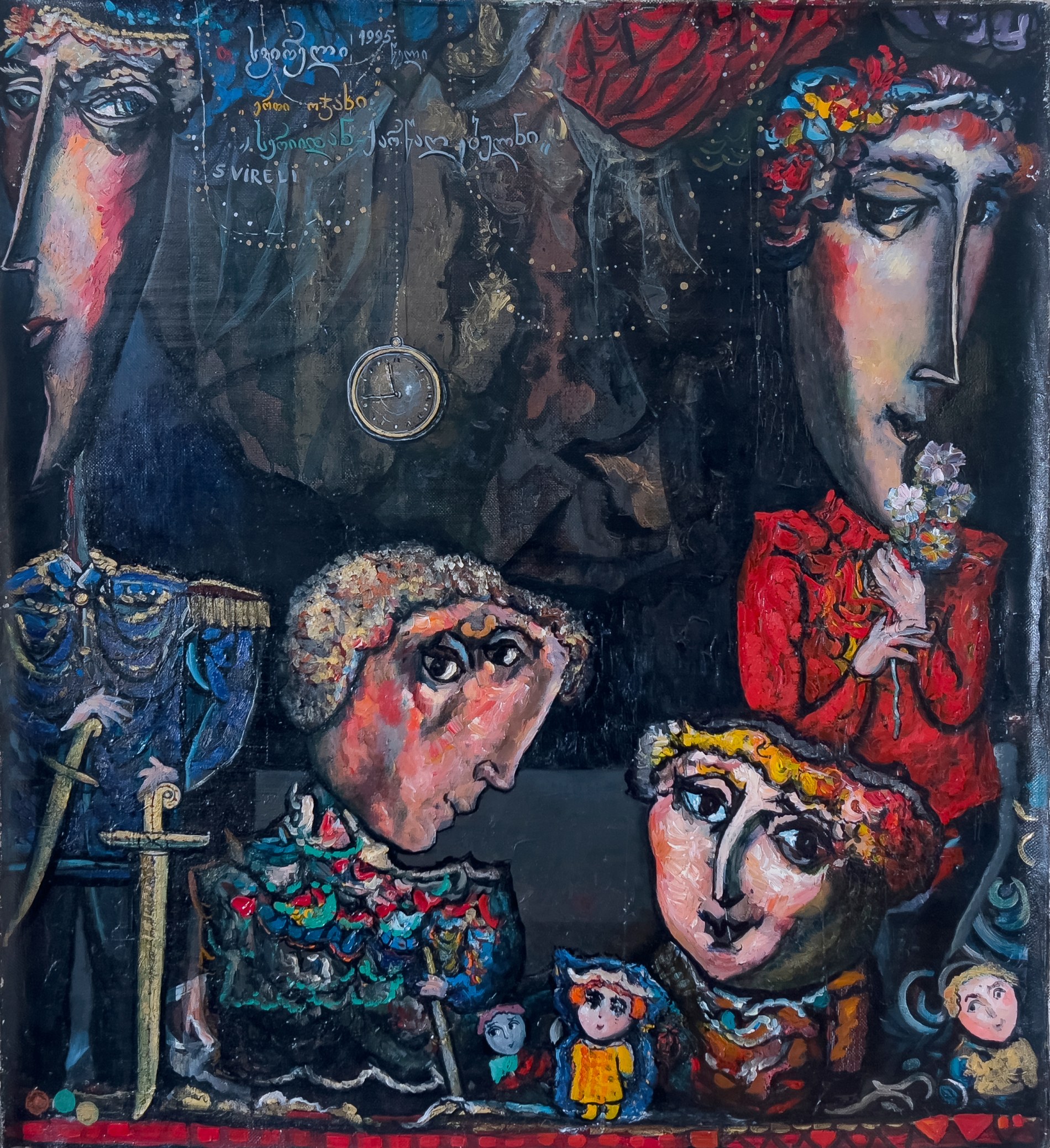
The series of paintings "Comedians," "Inhabitants of a Small Town," "Favorites of the Moon" are the most well-known in Svirely's oeuvre. People resembling multicolored sea pebbles, big children and little children, live under the protection of multicolored windows, balconies, and roofs of their toy town. Sometimes pieces of foil, beads, strips of fabric are glued right onto the canvas, creating a chord of pure color, improvisational frenzy, an interesting game. Strangely enough, the impetus for such painting came from experiences during the war in Georgia: "I saw human faces, gray with fear in the Tbilisi metro, while there was gunfire in the streets…”
And so this character appeared – a little boy – in a winter town and in a summer town, near an enormous forest, at the edge of a lake-like puddle, resembling the most precious stone in the Universe. This is the Soul of the World. The world of grace and love, peace and joy became a response to life's dark dangers.
And this is precisely why Antoine de Saint-Exupéry, in the midst of World War II, in 1942, wrote his great philosophical fairy tale. In this tale, the Little Prince speaks of kindness, mercy, and love –and in doing so gives hope to the pilot who crashed in the desert, to his planet, and to ours. And the pilot's planet seems to be freezing over with indifference and hostility. The soul of the Little Prince is the nature of any artist, with a living heart that knows how to love.
.jpg)
The final series "May Gardens" and "Untitled" rise in broad synthesis above all the artist's searches and discoveries. Large-scale paintings, grouped as shields, create an image of complex, infinite, and wondrous, harmonious existence in bloom. The world has finally been grasped in calm, mature contemplation. Here the presentation of the theme unfolds like a majestic fugue. Music itself, as an abstract suprasensory system of intervals, resounds in these programmatic "May Gardens". Emotional power combined with rational choice of means reveals its distinctive qualities here. The immense scale of the paintings strives to expand further, beyond the boundaries of the pictorial plane. Present within is a solemn emanation of color, the enamel density of the point-like brushstroke as an independent painterly corpuscle.
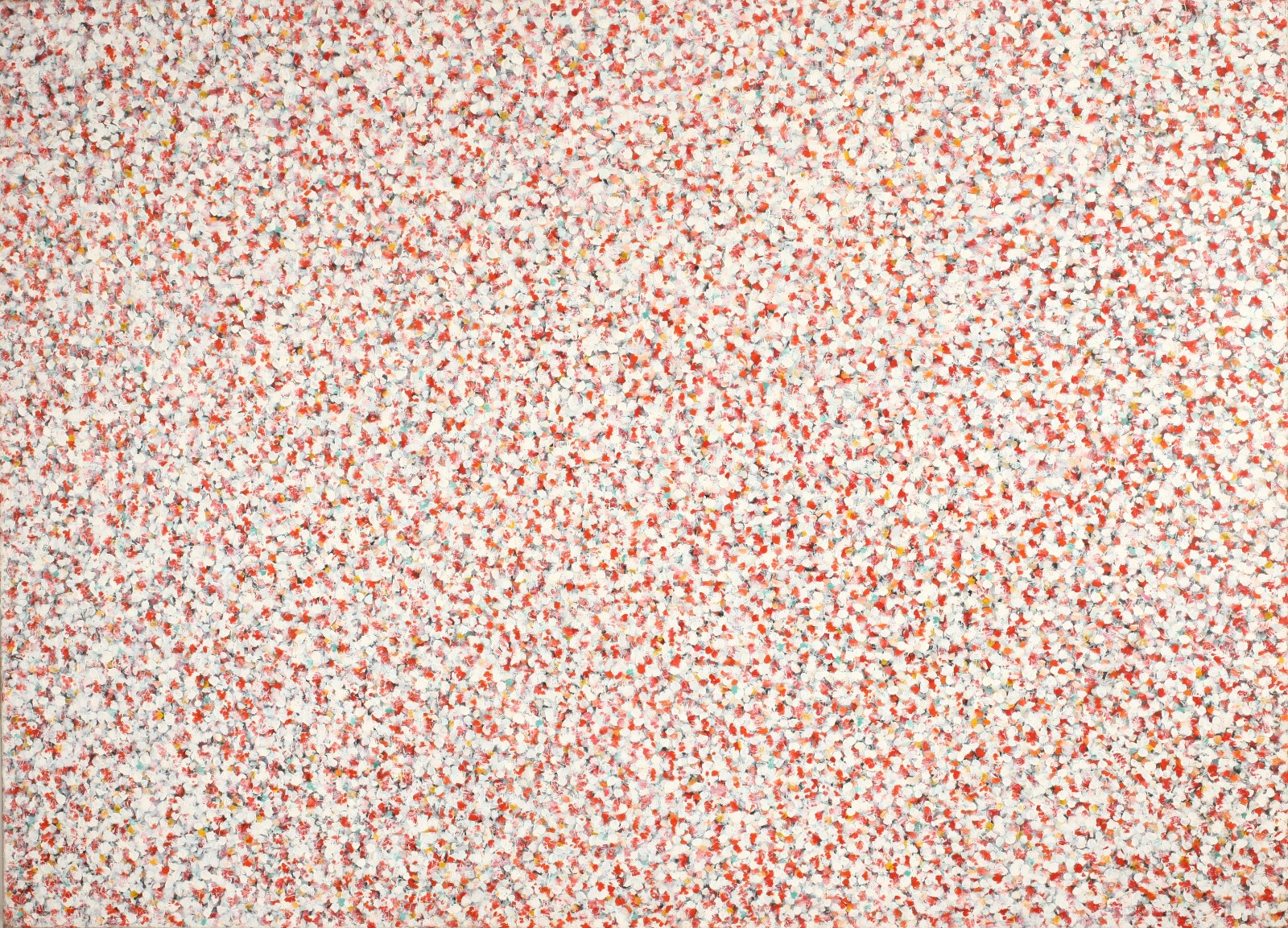
This swarm of petal-like splashes in a stately rhythm and structure becomes the ovary and genesis of new life. This is precisely what the emergence into pure painting looks like – the summit of synthesis, the Summa summarum of an ascetic's prayers, embodying the entire ecstatic grandeur of God's world. The very existence of such painting as part of pure form is an expression of cosmic being as a whole and originates from the great intuition we call God.
Dmytro Korsun
2004
Updated and translated in 2026.